Posts

Showing posts with the label UPF

Stats about Western Packaged Food Giants in India

Image
Key stats from a Reuters article about Western packaged food giants which have been in India for a century and the packaged food market: Some 6 billion meals eaten in India each year are Swiss food giant Nestle's Maggi instant masala noodles. Maggi launched India's first brand of instant noodles in 1983 , targeting newly working mothers and children ​as a fast evening snack. All variants of Maggi are made ​with palm oil, whereas many versions sold in Britain use pricier sunflower oil.  Coca-Cola's Thums Up has grown into a more than $1 billion local brand. Coca-Cola Co bought the brand for about $60 million in 1993 to slowly phase it out and replace it with its own flagship drink. But Indian shoppers were so loyal to the taste ⁠that Coke decided ​to keep it.  Unilever began selling "Dalda" - a hydrogenated vegetable oil formulation - in India in 1937 . Unilever’s Indian subsidiary Hindustan Lever Limited (HLL) sold the Dalda brand to US‑based Bunge in June 200...

India’s $100B Food Industry Challenges FSSAI Warning Labels in Supreme Court

Image
Reuters has reported that the more than $100 billion packaged-food industry, through the All India Food Processors’ Association (AIFPA), filed a court submission (intervener’s affidavit) in the Supreme Court seeking review/re-examination of the planned FSSAI front-of-pack warning labels (red hexagonal labels for products high in added sugar, salt, and/or saturated fat). The filing argues that many staples risk being covered in warnings that “will tarnish the image of Indian food globally.”  AIFPA referred to its earlier submissions to the regulator claiming that nearly 80% of packaged-food products may fall into the high fat, sugar, or salt category under the proposed thresholds (based on per-100g/100ml absolute values drawn from ICMR-NIN Dietary Guidelines).  The 80% figure is the industry body’s own estimate/claim (not an independent verification), raised to argue the thresholds are too strict and need scientific re-examination in light of Indian dietary patterns, serving s...

Front of Pack vs Ingredient List: Americana Coconut Cookies

Image
There’s something comforting about a packet of coconut cookies. The name alone promises a little tropical escape in every bite. But one of the more interesting parts of modern snacking isn’t the crunch — it’s what happens when you actually flip the pack over. According to the product listing on Open Food Facts , the ingredients for Americana Coconut Cookies read: refined wheat flour (maida), sugar, refined palm oil, invert syrup, coconut powder (1.96%), leavening agents [503(ii) & 500(ii)], edible starch, edible common salt, emulsifiers [322 & 471], acidity regulator [450(i)], artificial flavouring substances (butter & coconut), and preservative (223). That it is a coconut cookie is technically correct but that 1.96% coconut powder figure is hard not to smile at. The cookies still deliver a clear coconut flavour, helped along by the artificial flavouring, while the bulk of the recipe is the familiar cast of flour, sugar and palm oil that most biscuits rely on. It’s a neat r...

Let’s Try "Krunchy" Dabbang Masala Statutory Warning Explained (MSG Alert?)

Image
Most snack packets are only worried about ONE thing: Making sure you finish the pack in one sitting. Image: Open Food Facts But the snack brand Let's Try goes the extra mile with a Statutory Warning for its "Krunchy" Dabbang Masala on the back of the pack: Not recommended for children below 12 months and pregnant women. That’s right. While other chips are busy shouting “CRUNCHY!” and “CHATPATA!”, this packet is quietly side-eyeing babies and expectant mothers like a concerned auntie at a family function. The most likely culprit? The flavour enhancers (INS 621 & INS 635) — better known as Monosodium Glutamate (MSG) and its tasty cousins. They’re the reason the snack tastes so moreish… and also why the packet suddenly developed a maternal instinct. It’s oddly wholesome, in a “we want you to enjoy this, but not too early in life” kind of way. Although the pack lists Monosodium Glutamate under Allergen Information, MSG is not an allergen according to food regulators (FDA,...

Timeline of Front‑Of‑Pack Labelling in India

Image
Front-of-Pack Labelling (FOPL) is a public health initiative aimed at making nutritional information easier for consumers to understand. Chile introduced mandatory front‑of‑pack warning labels in 2016, becoming the first country worldwide to require clear black octagonal signs stating “High in sugar,” “High in sodium,” “High in saturated fat,” or “High in calories.”  Shoppers quickly learned to avoid products with multiple warning labels. Chile's food industry responded by reformulating products to reduce sugar, salt, and fat to avoid labels.  The policy has significantly reduced purchases of unhealthy foods and inspired similar regulations in Mexico, Argentina, Colombia, and Brazil. WHO praised Chile’s system as the most effective globally. In India, Food Safety and Standards Authority of India (FSSAI) has been working on front-of-pack nutrition labels (FOPL) for over a decade. Here’s the timeline based on the latest information: 2014: FSSAI first framed guidelines for FOPL,...

Poisons That Heal and Foods That Harm

Image
Poisons That Heal In the 1920s, cattle in the US and Canada began dying of internal bleeding after eating moldy sweet clover hay (Melilotus species, particularly Melilotus officinalis or Melilotus alba ). Mold converted natural coumarins in the plant to dicoumarol , which acts as a vitamin K antagonist and prevents blood clotting. Scientists isolated dicoumarol in 1940, and it was developed into early anticoagulant drugs (later leading to warfarin ). Digoxin (or more broadly, digitalis/cardiac glycosides from foxglove, Digitalis purpurea or Digitalis lanata )  is a cardiac glycoside that increases the force of heart contractions and is still used to treat heart failure and atrial fibrillation. William Withering's 1785 book documented foxglove leaf preparations for treating dropsy (edema from heart failure).   Curare refers to plant-derived curare alkaloids such as d-tubocurarine from species like Chondrodendron tomentosum . Indigenous hunters in the Amazon used i...

Book Review: Salt Sugar Fat

Image
After hearing glowing recommendations for Salt Sugar Fat: How the Food Giants Hooked Us by Michael Moss on the Open Food Facts forum, I picked up the book with a simple question in mind: How can someone write 400 pages about three basic ingredients — salt, sugar and fat? Three months later, after slowly working my way through the book, the answer became clear. These three ingredients are not just kitchen staples. In the hands of the trillion-dollar processed food industry, they have been carefully engineered to make foods convenient, irresistible, and hard to stop eating. Reading the book was both validating and chilling. Validating, because many of us already suspect something strange about ultra-processed foods. Chilling, because Moss reveals just how deliberately these products are designed. Although the book focuses on American companies, the lessons apply globally. Multinational food giants routinely transfer successful strategies from one country to another. Take the example of ...

Ultra-Processed Foods (UPFs): The Quick Fix That Hurts

Image
Ultra-processed foods (UPFs) like sugary snacks and instant meals are everywhere, packed with ingredients you won’t find in your kitchen .  They’re cheap and tasty but loaded with sugar, unhealthy fats, and additives that hook you into eating more and skipping real food.  Research shows cutting back could boost your health, as UPFs drive obesity and even speed up aging . UPFs are biologically disruptive . The ICMR-NIN dietary guidelines for Indians highlight that non-communicable diseases (NCDs) are primarily caused by the consumption of ultra-processed foods and products high in fat, sugar, and salt (HFSS) . UPF consumption is exploding across all age and income groups and is driven by unchecked aggressive marketing, celebrity endorsements and “health halo” claims. Our food choices are shaped by income, government policies, and industry tricks, making UPFs hard to avoid .  Brazilian epidemiologist, Carlos Monteiro coined the term ultra-processed food and introduced the...

Analyzing Food with Open Food Facts: Pokeman Ramen Fun Masala

Image
Freshly prepared and minimally processed foods are good for health, while a higher degree of processing makes them unsuitable although they taste great. 😋 Image from OpenFoodFacts.org The catchy name "Pokeman Ramen Fun Masala" and colorful packaging is designed to appeal to children. Let's review the analysis of Open Food Facts (OFF) for this product -  Pokeman Ramen Fun Masala 's ingredients are typical for instant noodles - Refined Wheat Flour (Maida), Edible Vegetable Oil (Palm Oil), Dehydrated Pieces 4.28% (Corn, Green Peas, Carrot, French Beans & Curry Leaves), Sugar, Iodised Salt, Hydrolysed Vegetable Protein Powder (Soya), Onion Powder Corn Starch, Mixed Spices 1.23% (Turmeric, Coriander, Black Pepper, Cumin, Fenugreek, Ginger, Clove, Nutmeg & Green Cardamom), Maltodextrin, Yeast Extract Powder, Flavour Enhancers (INS 631, INS 627 & INS 620), Acidity Regulators (INS 500(i), INS 451(i) &INS 330], Thickener (INS 415) & Antioxidant (INS 319)  ...

Only in India - Corn Puffs Pretending To Be Hyderabadi Veg Biryani

Image
Image source - Open Food Facts Ever picked up a snack packet and laughed at the name?  One brand decided to call its mix of corn meal, oil, gram flour, salts, powdered spices, milk solids, citric acid, and the ever-present flavor enhancer (INS-621 or monosodium glutamate )… “Hyderabadi Veg Biryani.” Now, anyone who has had real Hyderabadi biryani knows it’s an elaborate affair of rice, vegetables (or meat), herbs, slow cooking, and aroma that lingers across the neighborhood. What you get here instead is a powdered shortcut, an unscrupulous seller's remix of pantry staples designed to taste like the idea of biryani. It’s a funny reminder of how processed foods borrow the names of beloved dishes to market themselves. “Veg Biryani” in this case is more about flavor dust than dum cooking. Next time you see such labels, remember—it’s not biryani, it’s branding. 👉 Real takeaway: always check the ingredients list, not just the fancy name on the packet.

What is Front-of-Pack Labelling?

Image
Front-of-Pack Labelling (FOPL)  is a public health initiative aimed at making nutritional information easier for consumers to understand. Rather than analyzing detailed nutrition tables, this system offers bold, simple warnings about a product's healthiness by highlighting high levels of salt, sugar, or fat. This helps people spot health risks quickly without reading small print on the back. Although people may not entirely stop purchasing it, much like how cigarette warnings haven't eradicated smoking, it will raise awareness and encourage both consumers and producers to be more mindful. Chile introduced the black octagonal warning labels (often called "stop signs") on packaged foods and drinks high in calories, sugar, saturated fat, or sodium in June 2016. This was part of the country's groundbreaking Law of Food Labeling and Advertising (Ley 20.606), which took effect on June 27, 2016. It was the world's first mandatory front-of-package warning label system...

UPF Watch: Comparing Brands on Ultra-Processed Foods

Image
The Access to Nutrition Initiative (ATNI) released a noteworthy report in 2023 analyzing the nutritional quality of 1,901 food and beverage products from 20 large global companies operating in India. The report’s summary concluded: “On balance, it is reasonable to conclude that the average healthiness of the products provided and sold by the largest Indian food companies is sub-optimal.” After reading that, I was curious to explore the NOVA classification of foods sold in India, using data from the Open Food Facts (OFF) India database, which includes nutrition details for over 16,000 packaged products. 📊 Check out How Processed Are Popular Indian Food Brands to see a brand-wise distribution of products by NOVA Group. Currently, the analysis covers 25 brands, but the plan is to gradually expand it to the 3,000+ brands listed in the OFF India database. We place a lot of trust in food brands. But since a majority of them also sell  ultra-processed foods (UPFs) , it’s vital to read...

Haldiram's

Image
Image Source: OpenFoodFacts.org Haldiram's , officially known as Haldiram Snacks Food Pvt. Ltd., is a prominent Indian multinational fast-food restaurant chain and foodstuff manufacturer with a rich history dating back to  1937 . It is estimated that  Haldiram's holds a near 13% share of India's $6.2 billion savoury snacks market . Founded by  Ganga Bhishen Agarwal  in  Bikaner, Rajasthan , as a confectionery and desserts shop, the company has grown to become widely recognised as  the country’s largest snacks brand , with Haldiram Snacks Foods serving as the parent entity.  The parent entity was formed in 2022 following a merger of Delhi-based Haldiram Snacks and Nagpur-based Haldiram Foods International. Its headquarters are now located in Noida, Uttar Pradesh. Haldiram has a major export market in almost every country with Indian immigrants. Haldiram's boasts an extensive product range of over 410 items of which some 13+ are ultra-processed according...

The Dark Side of Convenience: Processed Foods and the NCD Epidemic

Image
From a tweet by Dilip Kumar (@kmr_dilip) Data is published by National Family Health Surveys (NFHS), International Diabetes Federation (IDF), WHO & Indian Council for Research on International Economic Relations (ICRIER). Computed all together.

😲 Sneaky Ingredient Changes - Britannia Good Day Cashew Cookies

Image
Back in 2018, a 600g pack of Britannia Good Day Cashew Cookies costed Rs 105. Thanks to an archived image from 2018 from Open Food Facts , if you check the list of ingredients, you'll see that Cashew Nuts constituted 4.5% of the weight. All images are from Open Food Facts - the Wikipedia of Food By mid 2024, the cost increased to Rs 135 and the Cashew content reduced to 1.8%! 😲 Can a cookie with a mere 1.8% cashew content truly earn the title of "Cashew" Cookie? It's like calling a splash of lemon in water "lemonade"! Other brands' packaging might lead you to believe their biscuits are brimming with nuts, but a closer look at the ingredients list often reveals a nutty illusion rather than a nut-filled reality. UNIBIC's Kesar Cashew Badam Cookies boast a 'nutty' 1% of actual nuts, and the exotic Kesar or Saffron flavor? Well, that's courtesy of some creative artificial flavoring substances. 😦 McVitie's Tasties Cashew & Almond Co...

😲 Same Barcode, Changed Ingredients - Everyday 100% Whole Wheat Bread

Image
If you thought the packaged food product you bought after checking its ingredients last year remain the same today, you could be in for a surprise. Let's look at the labelling of Everyday 100% Whole Wheat Bread The ingredients and nutritional information are presented in smaller print compared to the eye-catching marketing text - The label in November 2024 The ingredients list from November 2024 & January 2023 are listed below in the  following table. All images are from Open Food Facts - the Wikipedia of Food (click on dates in the table to see more about this product) November 2024 January 2023 Notes Whole Wheat Flour Whole Wheat Flour Same but percentage not mentioned - Wheat Bran Missing in new formulation - Gluten Sugar Sugar Yeast Yeast Iodised Salt Salt Refined Palmolein Oil Edible Vegetable Oil Transpar...

Food Additives: Hidden Dangers in Packaged Food

Image
Food additives are substances added to food to preserve its flavor or to enhance its taste, appearance, or other sensory attributes.  Some additives have been utilized for centuries to preserve food, such as vinegar for pickling, salt for curing, smoke for smoking, and sugar for crystallization.  These methods enable the preservation of foods like bacon, candies, or wines. With the rise of ultra-processed foods (UPFs) in the latter half of the 20th century, numerous additives, both natural and synthetic, have been introduced.  Food additives also encompass substances that may be indirectly introduced to food during the manufacturing process, through packaging, or while in storage or transit, known as "indirect additives." Food additives can be broadly divided into the following categories: Category Description Common Examples Acidulants Confer sour or acid taste. ammonium hydroxide, sodium carbonate, vinegar, citric acid, tartaric acid, malic acid, fumaric aci...

Economic Survey Flags Obesity as a Major Threat to India's Health

Image
The Economic Survey 2023-24 [PDF] , tabled on July 22, 2024 in Parliament, had raised concerns over two critical aspects of health: the rise in obesity and mental health crisis. Highlights: 56.4 per cent of the total disease burden in India is due to unhealthy diets. Obesity is emerging as a serious concern among India’s adult population.  Rise in children is the steepest in the world for India, behind Vietnam and Namibia. The incidence of obesity is significantly higher in urban India than in rural India. Over 100 million people in the country may have diabetes, one of the most common non-communicable diseases (NCDs). The prevalence of NCDs in India has tripled since 1995. Nutrition literacy must be promoted in schools, primary health care settings and through mass media.  The  Economic Survey 2024-25 [^PDF], reported that ultra processed food consumption (a key contributor to NCDs) in India surged from $900 million (2006) to $37.9 billion (2019), growing at over 33% a...

Unwrapping India's Bread: A Nutritional Analysis 🍞

Image
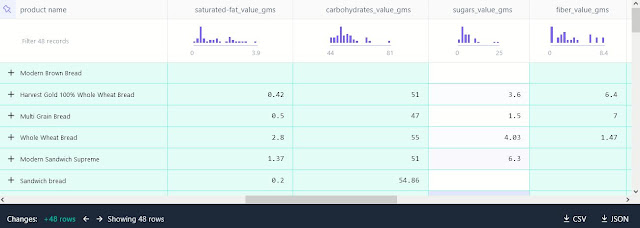
During a recent deep dive into  Breads category of the India database of Open Food Facts  - the 'Wikipedia of food', I analyzed 47 products (with known nutrition facts as of February 23, 2024). 44 of these products received a Nova Group grading of 4, indicating Ultra-Processed Food (UPF) status , the red alert for unhealthy choices! 32 of these breads show Palm oil as an ingredient on the packaging. Most of the remaining cloak themselves in the vague term 'Edible Vegetable Oil'. The data, which has been obtained from Open Food Facts and subsequently cleaned up, is available on GitHub in CSV format . To make it easier to slice and dice the data, view the above data on Github with the Flat Viewer tool : Any one column can be pinned to make data easier to analyze while scrolling. Data in all columns can be sorted as well. Slide through the numbers on the graphs to filter the records with numerical data or type keywords in case of textual data. Click on the Clear Filters l...