Posts

Showing posts with the label FSSAI

HOW TO Spot Genuine Organic Products in India

Image
Organic foods come from farming practices that focus on biodiversity, healthy soil, and chemical-free methods, all while taking an environmentally and socially responsible approach.  Tips for avoiding misleading “organic” claims from uncertified brands and identifying genuine organic products: 1.  Check the logo - Only certified organic foods can carry it. The FSSAI “Jaivik Bharat” initiative provides a unified certification and logo for organic foods in India, based on the Food Safety and Standards (Organic Foods) Regulations, 2017 [^ PDF ].  Green circular mark with “Jaivik Bharat” tagline symbolizes compliance with national organic standards. The Food Safety and Standards (Organic Foods) Regulations, 2017 recognize two systems of certification i.e. Participatory Guarantee System (PGS) implemented by Ministry of Agriculture and Farmers Welfare and National Programme for Organic Production (NPOP) implemented by Ministry of Commerce and Industry 2.  Look for certifi...

Labelspotting: Is Your “Ice Cream” Really Ice Cream?

Image
There’s a special kind of magic in the freezer aisle. You reach for something that looks like ice cream, feels like ice cream and tastes remarkably like ice cream.  Then you flip the pack over and discover you’ve actually been invited to a slightly more complicated party. Images: Open Food Facts The ingredients list reads like a carefully negotiated treaty between dairy and the vegetable kingdom: potable water, sugar, milk solids, and then refined palm oil (along with its friends maltodextrin, starch, emulsifiers, stabilisers, and a supporting cast of colours and nature-identical flavours). The pack helpfully notes it contains 4.5% edible vegetable oil. That’s the quiet plot twist. What you’re enjoying isn’t ice cream at all, but a frozen dessert. So yes, you can call it “fake ice cream” if you’re feeling dramatic. Just know the manufacturers have already done the legal paperwork and called it something else. It looks the part. It melts the part. It delivers that soft, creamy hit o...

The Green Dot Paradox: Can Vegetarian Protein Powder Have Cholesterol?

Image
In India, a green dot inside a green square indicates that the food contains no meat, eggs, or animal products. So what happens when you pick up a tub of SuperYou Pro Fermented Yeast Protein (Chocolate) , spot the official Green Dot India icon on the label, turn it around to read the nutrition table, and see Cholesterol 2.84mg listed right there?  Image: Open Food Facts It feels like a contradiction. We are conditioned to believe two fundamental ideas: Cholesterol only comes from animals. The Green Dot means 100% vegetarian. If both are true, is the green dot a mistake? Is the brand breaking the rules, or is our basic biology textbook out of date? The Science: Where Did the Cholesterol Come From? Let's look at what is inside this tub. The protein source in SuperYou Pro isn't whey (which comes from cow's milk) or soy/pea (which comes from plants). It is Fermented Yeast Protein Isolate, specifically made using Saccharomyces cerevisiae —the exact same microorganism used for ce...

Reused Oil is a Silent Killer

Image
Here is a simplified guide on why reusing frying oil is dangerous and what the food safety regulations mean for your health. Why Reused Oil is a "Silent Killer" Every time you reheat oil for frying, it breaks down and loses its natural antioxidants. This degradation creates Total Polar Compounds (TPC) —toxic by-products that are directly linked to several chronic diseases. Long-Term Health Risks Regular consumption of food cooked in reused oil is not just about a bad stomach; it has serious long-term consequences: Heart Health: Increases "bad" cholesterol (LDL), leading to hypertension (high blood pressure), atherosclerosis (clogged arteries), and stroke. Metabolic Disorders: Linked to a higher risk of Diabetes and Obesity. Liver & Brain Health: Associated with liver damage and neurodegenerative diseases like Alzheimer’s. Cancer: The formation of carcinogenic molecules like acrylamides and aldehydes during reheating can increase the risk of various cancers. The ...

Choconomics

Image
High cocoa prices have triggered a wave of “reformulations” — the industry’s polite term for recipe changes across the U.S. chocolate market. The familiar “milk chocolate” label (a term regulated by the FDA) is quietly being replaced by the more flexible “chocolate candy.” Over the last decade, climate change has added six extra weeks of extreme heat every year to most West African cocoa-growing regions. The result? Declining yields and rising prices. Major players like Nestlé have saved more than $500 million by adjusting recipes in response to the cocoa and coffee price surge. To cut costs, companies are swapping cocoa butter for vegetable fats, using compound coatings, and adding emulsifiers like E476 (polyglycerol polyricinoleate) to stretch limited cocoa supplies. Others are bulking up bars with sugar or chunky add-ins or even switching to cheaper beans and different manufacturers. Chocolate Standards: A Global Contrast Source: Surbhi Bhatia U.S. (FDA): Milk chocolate must contai...

FSSAI Calls Out Misleading “100%” Claims — Will Brands Comply?

Image
On 25th May 2025, FSSAI has advised Food Business Operators (FBO) to stop using the term “100%” on product labels and ads , calling it ambiguous and potentially misleading under current regulations. Under the Food Safety and Standards Act, 2006, an FBO refers to: "Any person or entity engaged in the manufacture, processing, packaging, storage, transportation, distribution, or sale of food." According to FSSAI, “100%” is not defined under the Food Safety and Standards (Advertising and Claims) Regulations, 2018, and its use can be ambiguous and misleading. The regulator notes that such claims may create a false impression of absolute purity or superiority over other products. Hence, food businesses are required to ensure that all claims remain truthful, clear, and not misleading. Meanwhile, the  Open Food Facts database of packaged food products  shows that several products — from fruit juices and whole wheat flour to atta bread and protein powders — continue to carry “100%...

The Fake ORS Battle: A Doctor's Crusade for Kids' Health

Image
In the chaos of 1971's Bangladesh refugee crisis, Dr. Dilip Mahalanabis , an Indian pediatrician, made a lifesaving breakthrough. Amid cholera outbreaks killing thousands from dehydration, he pioneered Oral Rehydration Solution (ORS)—a simple mix of water, salt, sugar, and electrolytes that could be sipped to replace lost fluids. Without fancy labs or equipment, his field trials in refugee camps saved over 50,000 lives, slashing death rates from 30% to 3%. This humble invention became a global game-changer, hailed by the World Health Organization as one of the 20th century's top medical advances, and it's still a staple in every Indian home for fighting diarrhea. Fast-forward to modern times - ORS got a twisted makeover with products like Electral .  Image - OpenFoodFacts.org Launched in the 1970s as a legitimate electrolyte powder, it soon faced copycats—sugary energy drinks masquerading as ORS.  These "fake ORS" emerged in the 2000s, packed with high fructose...

How does your State/UT fare in Food Safety?

The Food Safety and Standards Authority of India (FSSAI) is responsible for ensuring public health by promoting food safety. The FSSAI and State Food Safety Authorities share this responsibility as outlined by the Food Safety and Standards Act 2006. The FSSAI provides policy intervention, direction, and coordination at the national level, while States/UTs conduct food safety enforcement at the field level. To incentivize States and UTs to enhance food safety within their regions, the FSSAI announces the State Food Safety Index (SFSI) annually. This index is based on performance in five significant parameters: Human Resources and Institutional Data, Compliance, Food Testing-Infrastructure and Surveillance, Training & Capacity Building, and Consumer Empowerment. The chart below represents the State Food Safety Index (SFSI) scores PDF for different states and Union Territories in India.  The marking for the Index is based on data from various FSSAI online portals such as FoSCoS,...

FSSAI Orders Removal of '100% Fruit Juice' Tag For Reconstituted Products

Image
Image source: Open Food Facts The FSSAI has issued a directive requiring all food business operators to cease using the claim "100% fruit juice" on labels and advertisements for reconstituted fruit juices, effective immediately. After a detailed review, the FSSAI determined that the Food Safety and Standards (Advertising and Claims) Regulations, 2018, do not allow for a "100%" claim. Such claims are considered misleading, especially when water is the main ingredient and the primary ingredient is only present in small amounts. The term "reconstituted" must be clearly stated next to the juice's name in the ingredient list if it is made from concentrate. Furthermore, the regulator stated that if added nutritive sweeteners are more than 15 gm/kg, the product should be labeled as "Sweetened juice."

Milking the Data: Analyzing India's Packaged Milk Market🐄

Image
I analyzed 55 products (with known nutrition facts as of April 5, 2024) across 22 brands in the Milks category of the India database of Open Food Facts - the 'Wikipedia of food'. The data, which has been obtained from Open Food Facts and subsequently cleaned up, is available on GitHub in CSV format . You can also view that curated dataset with the Flat Viewer tool .  Here are my findings and fun facts I discovered - * In India, dairy products are a primary source of protein for vegetarians, and Ayurveda, an ancient system of medicine, recommends daily milk consumption. * Dairy products, especially milk, were consumed on the subcontinent at least from the Vedic period  (1500 – 500 BCE).  * Milk protein contains all 9 essential amino acids required for recovery and vital functions.  * The mid-20th century witnessed the White Revolution, or Operation Flood , led by Dr. Verghese Kurien , transforming India into the world's largest milk producer. A breakthrough in making...

Unwrapping India's Bread: A Nutritional Analysis 🍞

Image
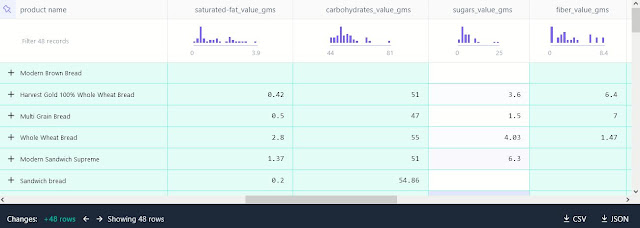
During a recent deep dive into  Breads category of the India database of Open Food Facts  - the 'Wikipedia of food', I analyzed 47 products (with known nutrition facts as of February 23, 2024). 44 of these products received a Nova Group grading of 4, indicating Ultra-Processed Food (UPF) status , the red alert for unhealthy choices! 32 of these breads show Palm oil as an ingredient on the packaging. Most of the remaining cloak themselves in the vague term 'Edible Vegetable Oil'. The data, which has been obtained from Open Food Facts and subsequently cleaned up, is available on GitHub in CSV format . To make it easier to slice and dice the data, view the above data on Github with the Flat Viewer tool : Any one column can be pinned to make data easier to analyze while scrolling. Data in all columns can be sorted as well. Slide through the numbers on the graphs to filter the records with numerical data or type keywords in case of textual data. Click on the Clear Filters l...

FSSAI License Verification

Image
A Food Business Operator (FBO) operating in more than two States has to get Central License for its registered Office/ Head Office and separate license/ Registration for each unit depending upon the capacity/ turnover from the concerned State/ Central Licensing Authority. Food Safety Compliance System (FoSCoS) is an enhanced version of Food Licensing and Registration System (FLRS) which was launched in 2012 for issuance of pan-India FSSAI Licenses and Registration.  To verify details of the manufacturer, use the Search feature via the 'FBO Search' tab on the FoSCoS website  - Individual or state-wide licenses can be retrieved. Inactive licenses are also listed in the results. FSSAI license number details that are shown include: FBO/company name. Premises address. License number. License type (State License or Central License). Validity (whether active or inactive). List of products of the FBO To safeguard the interests of the consumer and the society at large, Food Safety and ...

FSSAI Food Categories

Image
Under the Food Safety and Standards Act, 2006, Food Safety and Standards Authority of India (FSSAI) is responsible for framing standards for food products and for food safety.  The Food Safety and Standards (Food Product Standards and Food Additives) Regulations, 2011 initially prescribed standards for 377 products/product categories. Since, then additionally standards for 134 products have been finalized and notified and an equal number of the product standards are in the process of being finalized. As of 2021, there are 18 Main categories of food  and another about "Substances added to food" defined by FSSAI and represented by numeric codes: Dairy products and analogues Fats and oils, and fat emulsions Edible ices, including sorbet Fruits and vegetables (including mushrooms and fungi, roots and tubers, fresh pulses and legumes, and aloe vera), seaweeds, and nuts and seeds Confectionery Cereals and cereal products, derived from cereal grains, from roots and tubers, pulse...