Indian Fruits
While exotic berries fly thousands of miles in plastic clamshells, everyday Indian fruits quietly pack staggering amounts of dietary fibre, heat-stable Vitamin C, and rare plant compounds—often for a fraction of the rupee. They are often far more affordable than packaged fruit juices, which frequently rely on misleading claims like "Real" and "Fresh," yet may contain only about 10% fruit, typically from processed concentrate.
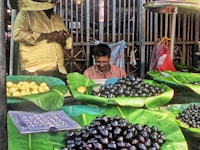 |
| A vendor selling dark purple jamun |
When comparing fruits using IFCT 2017 (Indian cultivars) alongside USDA benchmarks (per 100 g raw edible weight), chickoo consistently ranks at or near the very top among fresh fruits:
| Fruit | Fibre / 100g | Carbs / 100g | Nutritional Highlight |
|---|---|---|---|
| Chickoo (Sapota) | 9.6 g | 13.9 g | Highest fibre among common fresh Indian fruits; rich in soluble & insoluble fibre plus natural tannins. |
| Guava (Amrood, white) | 8.6 g | 5.1 g | Vitamin C powerhouse (214 mg/100g—over 3× daily need) with seed-rich insoluble fibre and low sugar. |
| Amla (Gooseberry) | 7.8 g | 4.4 g | Heat-stable Vitamin C (252 mg/100g) and potent polyphenols (gallic & ellagic acid). Very dense in insoluble fibre. |
| Karonda | 7.2 g | 3.9 g | Tart, iron-bearing berry rich in pectin and anthocyanins; aids digestion. |
| Bel / Bael Fruit | 6.3 g | 28.2 g | Gummy soluble fibre and top-tier potassium (409 mg), folate (55 μg), and Vitamin E; note that Wood Apple (Kaitha) has 5.2 g fibre, 7.5 g carbs & 636 mg Omega-3. |
| Custard Apple (Sitaphal) | ~5.2 g | 20.4 g | Energy-dense fruit rich in potassium, magnesium, and Vitamin B6 for heart rhythm and nerve function. High pulp fibre. |
| Pomegranate (Anar) | ~4.2 g | 11.6 g | Loaded with punicalagins and ellagitannins—antioxidants supporting vascular health. Fibre comes primarily from chewing the crunchy aril seeds. |
| Pear (Nashpati) | ~3.7 g | 9.8 g | Gentle, gut-soothing soluble pectin and sorbitol; best eaten with skin as it provides roughly half of its total dietary fibre. |
| Jackfruit (Ripe) | 3.6 g | 14.0 g | Ranks among top fruits for protein (2.7 g/100g), folate (32 μg), and Vitamin K1 (37 μg); boiled seeds add 8.6 g fibre & 5.8 g protein. |
| Pineapple | 3.5 g | 9.4 g | Good Vitamin C source (36.4 mg/100g) and contains bromelain, a natural protein-digesting enzyme. |
| Jamun (Jambu Fruit) | 3.1 g | 6.8 g | Low calorie (56 kcal) & low sugar; rich in anthocyanins and astringent tannins. |
| Apple (with skin) | ~2.5 g | 13.1 g | Cholesterol-binding pectin fibre paired with quercetin (anti-inflammatory flavonoid in peel). |
| Banana (Ripe) | ~2.4 g | 24.9 g | High potassium & Vitamin B6; slightly unripe fruit supplies prebiotic resistant starch. |
| Mosambi (Sweet Lime) | 2.1 g | 5.2 g | Very low calorie (27 kcal) and low acid; provides 47 mg Vitamin C and citrus flavanones (hesperidin & naringenin) gentle on sensitive stomachs. |
| Papaya / Mango | ~1.7 g | 4.1–7.8 g | Rich in beta-carotene (provitamin A); mango leads fruits in folate, while papaya supplies papain, a natural protein-digesting enzyme. |
| Musk Melon (Orange flesh) | 1.5 g | 4.2 g | 93% water and just 23 kcal; top-tier beta-carotene (771 μg), folate, and potassium for summer hydration. |
| Grapes (Seeded black) | 1.4 g | 13.2 g | Quick energy from natural sugars paired with skin polyphenols (resveratrol & anthocyanins) and Vitamin C. |
| Orange (Pulp) | 1.3 g | 7.9 g | Supplies 42.7 mg Vitamin C alongside non-heme iron (0.81 mg), thiamine, and folate—its own Vitamin C boosts iron absorption. |
| Watermelon (Sugar baby) | 0.7 g | 3.9 g | Lightest fruit in IFCT (20 kcal, 94.5% water); rich in beta-carotene (605 μg) and lycopene. |
| Dragon Fruit (Kamalam) | Not in IFCT | Not in IFCT | Low-calorie cactus fruit (~50–60 kcal, ~3 g fibre); red-fleshed varieties supply betacyanin antioxidants and prebiotic oligosaccharides. |
| Kokum | Not in IFCT | Not in IFCT | Source of garcinol (antioxidant) and hydroxycitric acid (HCA); cooling low-calorie acidulant. |
Fun Facts
Guava, jamun, karonda, grapes, and apples give you virtually every gram you pay for—peel, pulp, and edible seeds included (and that thin skin is where most of the fibre and polyphenols hide anyway).
Chickoo and bananas keep their wrappers paper-thin, meaning ~80–85% of your grocery bag weight lands straight on your plate—unlike watermelons or wood apples, where half the weight goes straight to the compost bin.
Jackfruit looks like a spiky, waste-heavy giant, yet Indian kitchens turn almost the entire fruit into food—ripe bulbs for dessert, raw flesh (kathal) as a meaty vegetable, and even the protein- and fibre-rich seeds (8.6 g fibre & 5.8 g protein per 100 g) boiled or roasted like chestnuts.
Dried fruits like dried figs/anjeer at ~9.8 g/100 g and dates at ~8.0–8.9 g/100 g appear to have higher fibre on paper purely because water has been removed, concentrating their nutrients.
- co-written with Gemini



Comments
Post a Comment